What Does Organic SEO Actually Include for a Small Business?
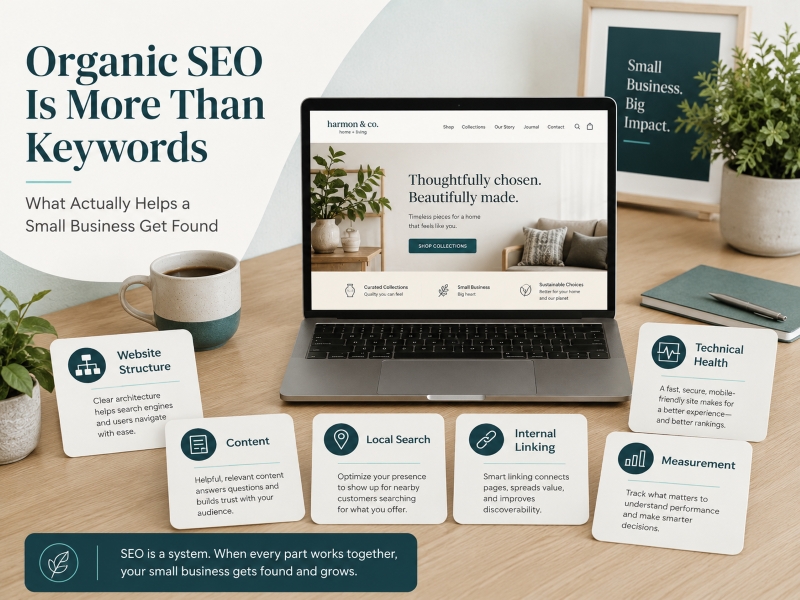
SEO is more than keywords, rankings, and a plugin score. For a small business, effective organic SEO combines website structure, useful content, technical fundamentals, local relevance, and ongoing improvements that help both people and search systems understand what the business does.
Ask ten people what SEO means and you may get ten different answers. One person will talk about keywords. Another will mention backlinks. Someone else may point to a green score inside a WordPress plugin and assume the job is finished.
For a small business owner, that makes SEO harder to evaluate than it needs to be. If you are paying someone to improve your organic search visibility, what are they actually supposed to be doing?
Practical organic SEO is not one task. It is the process of making a website easier for search engines to understand, more useful for the people who find it, and more relevant to the services and locations the business wants to compete for. The pieces work together, and weaknesses in one area can limit the results of the others.
Organic SEO is not about adding keywords to a website. It is about helping search engines understand what the business does, where it does it, and why a page is useful to someone searching for that information.
It Starts With the Website Itself
Before worrying about complicated SEO tools or hundreds of keyword variations, the website needs a solid foundation. Search engines need clear pages, understandable navigation, logical relationships between topics, useful content, and a site that can be crawled and indexed properly.
One of the most common problems I see is a small business trying to make one general services page rank for everything it does. A homepage might mention website design, hosting, SEO, and technical support, for example, but that does not give search engines much depth about any one service. Focused service pages give each topic room to explain what is offered, who it helps, and how it solves a real problem.
This is one reason ProImpact's Organic SEO & Content Strategy work begins with the website itself rather than with a giant spreadsheet of keywords.
What Practical Organic SEO Includes
The exact priorities depend on the business and the condition of the existing website, but most small-business SEO work involves several connected areas.
Website Structure
Important services should have clear, dedicated pages rather than being buried in a paragraph on the homepage. Navigation, page hierarchy, URLs, and internal links should make the relationships between those pages easy to understand.
Service & Location Content
Search engines need enough useful information to understand what a company offers and where it operates. Strong service pages and legitimate location-specific pages help establish that relevance without repeating the same generic copy over and over.
Titles, Headings & Metadata
Page titles, H1 and H2 headings, meta descriptions, image information, and other on-page elements should reinforce what each page is actually about. These details matter, but they support good content rather than replace it.
Internal Linking
Relevant internal links help visitors discover useful information and help search engines understand how pages relate to one another. Blog articles should support service pages instead of existing as isolated posts with nowhere meaningful to go.
Technical Health
Broken links, redirect problems, indexing issues, slow pages, mobile problems, plugin conflicts, duplicate content, poor hosting, or incorrect settings can all interfere with search visibility even when the written content is good.
Useful Ongoing Content
Blog content works best when it answers questions real customers are already asking. Pricing concerns, comparisons, process questions, maintenance issues, seasonal topics, and common misconceptions can all create useful organic entry points.
Local Search Signals
For businesses serving a geographic market, location relevance matters. Website content, Google Business Profile information, consistent business details, reviews, service-area information, and other local signals help establish where the business actually competes.
Measurement & Adjustment
SEO is not finished when a page is published. Search Console, Bing Webmaster Tools, analytics, rankings, indexing data, conversions, and now AI citation information can all help show what is working and where the site may need additional attention.
Good SEO Content Answers Real Questions
A blog should not exist simply because someone said Google likes fresh content. Publishing weak articles every week does not automatically make a website more authoritative.
The stronger approach is to identify questions that customers actually ask and create pages that answer those questions clearly. Those articles can then support the main service pages through relevant internal links and give the website additional ways to appear when someone searches for information before they are ready to contact a business.
For example, a painting contractor may benefit from answering questions about paint sheen, preparation, cabinet finishes, project timelines, or whether a particular material can be painted. A CPA may answer questions about becoming an employer or financing business equipment. The subject changes, but the principle is the same: useful content should solve a real problem.
So, What Does Organic SEO Actually Include?
For most small businesses, organic SEO includes improving website structure, creating strong service and location pages, optimizing headings and metadata, strengthening internal links, addressing technical and indexing issues, publishing useful content, building local relevance, and monitoring performance over time.
No single item guarantees rankings. The value comes from making all of those pieces work together so search engines have a clearer understanding of the business and visitors have a better experience once they arrive.
Where AI Search Fits Into Organic SEO
Search is also changing. People increasingly receive answers directly from AI-assisted search systems rather than clicking through a traditional list of ten blue links. That does not make conventional SEO obsolete. In many ways, it makes the fundamentals even more important.
An AI system still needs to understand what a business does and find useful information that can help answer a question. Clear service descriptions, well-organized pages, strong internal relationships, useful explanations, consistent business information, and specific answers to customer questions can all make website content easier to retrieve and reference.
That does not mean a business can be guaranteed a particular “AI ranking.” AI-generated answers can vary by platform, query, location, and context. A more practical goal is to improve the likelihood that the business and its content can be understood, retrieved, cited, or recommended when relevant.
In other words, good organic SEO and good AI visibility are increasingly connected. A website that clearly explains its expertise is useful to both traditional search engines and newer AI-assisted discovery tools.
SEO Is Also About Knowing What Is Holding a Site Back
Sometimes the problem is not that a business needs more content. The website may already have plenty of pages but suffer from poor organization, duplicate material, thin service pages, indexing problems, weak internal linking, or technical issues that have accumulated over time.
That is why it is important to diagnose the website before assuming the answer is simply “more SEO.” If your site is difficult to find, the earlier ProImpact article Why Your Tucson Small Business Website Isn't Showing Up on Google explains several of the foundation problems worth checking first.
What SEO Does Not Include
Good organic SEO should not depend on promises that cannot reasonably be made. No provider controls Google's algorithm, competitors, search personalization, geographic differences, or the constant changes taking place in search.
It also should not require making every page sound as though it was written for a search engine rather than a person. Repeating a city name twenty times, forcing awkward keywords into every sentence, or publishing shallow articles solely to increase page count can make a website worse rather than better.
Page 1 visibility can certainly be the goal, but the work should focus on giving the website the strongest reasonable foundation to compete rather than promising a specific position that no SEO provider actually controls.
Frequently Asked Questions About Small Business SEO
How long does organic SEO take?
There is no universal timeline. Some changes can improve indexing or visibility relatively quickly, while competitive service and local searches may take months. The age of the site, competition, existing authority, quality of the pages, and technical condition of the website all affect how quickly results can change.
Does every small business need ongoing SEO?
Not every business needs an expensive monthly SEO program, but every website benefits from ongoing attention. Services change, competitors improve their sites, search engines update their systems, content becomes outdated, and technical issues can develop over time. The level of ongoing work should match the business and its competitive environment.
Are keywords still important?
Yes, but keywords are only one part of SEO. They help identify how people search for a service or question, but a page still needs useful information, clear intent, good structure, internal support, and enough depth to deserve visibility.
Can SEO help a business appear in AI answers?
Strong SEO fundamentals can improve the likelihood that AI systems understand and retrieve website content. Clear answers, useful expertise, strong page structure, consistent business information, and authoritative content can all support AI visibility, but there is no fixed AI ranking position that can be guaranteed.
Is SEO just about getting more website traffic?
No. More traffic is useful only if it is relevant. A smaller number of visitors who are actively looking for the services a business provides can be much more valuable than a large amount of unrelated traffic. Organic SEO should ultimately support qualified visibility, inquiries, and business goals.
The Goal Is a Website That Makes Sense to People and Search Engines
For a small business, SEO does not need to be mysterious. The strongest websites usually do the basics well: they explain the business clearly, give important services their own pages, answer useful questions, connect related information, maintain sound technical foundations, and continue improving based on what the data shows.
That is also why SEO works best as part of the broader website rather than as a completely separate marketing activity. Design, content, hosting, performance, maintenance, local relevance, and search visibility all affect one another.
You can see examples of how those pieces come together in ProImpact's small-business website and SEO projects .
Not Sure What Your Website Actually Needs?
You may not need a larger SEO package. You may need stronger service pages, better internal linking, technical cleanup, improved content, or simply a clearer picture of what is holding the website back. ProImpact starts by looking at the site and identifying what makes sense for the business.
Start a Conversation