
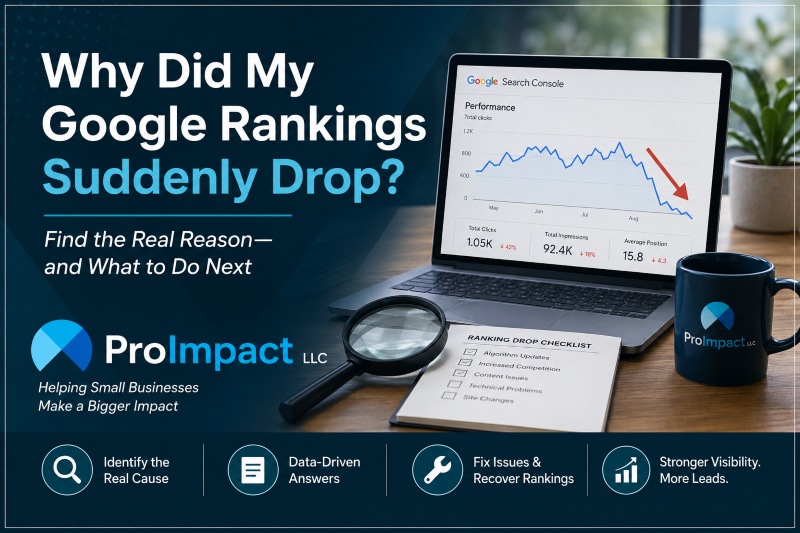
Why Did My Google Rankings Suddenly Drop?
A sudden Google ranking drop does not automatically mean your website is broken or that you need to rebuild everything. Rankings can move because of Google updates, stronger competitors, technical problems, website changes, indexing issues, or shifts in how well a page answers the search. The first step is finding out what actually changed before trying to fix it.
If your Google rankings suddenly dropped, compare your important pages and search queries in Google Search Console, check whether Google recently completed a ranking or spam update, and review any website changes made around the same time. A small movement may be normal. A sustained drop across multiple important pages deserves a closer look at indexing, technical problems, content quality, internal links, competition, and recent site changes.
Few things get a small-business owner's attention faster than opening a ranking report and seeing a keyword that was near the top of Google suddenly several positions lower. If the website depends on organic search for inquiries, the immediate reaction is usually some version of: What happened?
The uncomfortable part is that there is rarely one universal answer. Google rankings are not fixed positions that a website permanently earns. Competitors improve their pages. Search behavior changes. Google reevaluates content. Technical issues appear. A redesigned page may unintentionally lose something that was helping it. Sometimes nothing is fundamentally wrong and the ranking simply moves for a while.
That distinction matters because reacting too quickly can make the situation worse. Rewriting a page that is still performing well, changing URLs, removing useful content, or rebuilding a website before understanding the cause introduces new variables when the real problem may have been temporary.
A Google Ranking Drop Is a Signal, Not a Diagnosis
The first question should not be, “How do I get the ranking back?” It should be, “What actually changed?”
Start with the size and scope of the decline. One keyword moving from position three to position five is very different from several important service pages falling from the first page of Google into the twenties. The first may be normal search movement. The second deserves a more careful investigation.
Google itself recommends looking at Search Console data over time rather than reacting to isolated position changes. Search results are dynamic, and small fluctuations can occur without any action being necessary. Larger, sustained declines across important pages and queries provide a much stronger reason to investigate.
The goal is not to react to every ranking change. It is to recognize when the pattern tells you something meaningful has changed.
Why Google Rankings Drop
Most meaningful ranking declines fall into several broad categories. More than one can be happening at the same time, which is why looking only at a keyword report rarely tells the whole story.
Google Changed How It Evaluates Results
Google continually changes its search systems, and some larger updates are publicly announced. When rankings decline around the same time as a confirmed update, timing is worth noting — but timing alone does not prove that an update is the only cause.
For example, Google completed an August 2026 spam update earlier this month. That does not mean every ranking change in August was caused by that update. It does mean businesses evaluating an August decline should include the update in the timeline rather than assuming the website suddenly developed a technical problem.
A Competitor Became More Relevant
Losing a position does not always mean your page became worse. Sometimes another business simply improved. A competitor may have created a stronger service page, added useful supporting content, improved local relevance, earned stronger links, or better answered what people searching for that service appear to want.
Search rankings are comparative. Your website does not compete against an abstract standard; it competes against the other pages Google can show for the same search.
The Page Has Become Outdated or Too Thin
A service page that ranked well several years ago may no longer be the strongest result today. Competitors may now provide clearer explanations, better supporting information, stronger FAQs, more current examples, or a better user experience.
This does not mean every older page needs constant rewriting. It means important pages should still accurately represent the service, answer the questions potential customers actually have, and connect naturally with related information elsewhere on the website.
A Website Change Had an Unintended Effect
Ranking declines sometimes appear after changes that did not seem related to SEO at all. A page URL may have changed without the correct redirect. A heading may have been removed during a redesign. Important body copy may have been shortened. Navigation changes may make a page harder to reach. A canonical tag or indexing setting can also be changed accidentally.
That is why recent website changes should always be part of the investigation.
Google Is Having Trouble Crawling or Indexing the Site
Hosting outages, server errors, DNS problems, blocked resources, incorrect robots directives, accidental noindex settings, or other technical failures can interfere with Google's ability to reach and understand pages.
This is particularly important when a ranking decline follows a migration, hosting change, redesign, security incident, plugin problem, or server issue.
The Search Itself Has Changed
Sometimes the website is substantially the same but the search results around it have changed. Google may interpret a query differently, display a different mix of local results, emphasize another type of page, or respond to changing search behavior.
This is one reason a business should not judge its entire organic search performance by manually searching one phrase from one computer.
How to Investigate a Google Ranking Drop
The most useful investigation is methodical. You are trying to establish a timeline and determine whether the decline is isolated, widespread, technical, competitive, or related to the content itself.
Look at Search Console Before Changing Anything
Compare clicks, impressions, average position, important queries, and landing pages. Determine whether the change affects one keyword, one page, one group of pages, or the site more broadly.
Check Whether Google Announced an Update
Google's Search Status Dashboard records major ranking updates and search incidents. If the timing overlaps, make a note of it, but avoid assuming the update explains everything until you compare your own data.
Review What Changed on the Website
Look back several weeks. Were pages redesigned? Were URLs changed? Was a plugin installed? Did hosting change? Was content removed? Were title tags, navigation, redirects, or indexing settings modified?
Check the Pages That Replaced You
Search results provide useful competitive information. Look at the businesses now ranking above your page. Are their pages substantially more complete? Do they answer the search more directly? Is their local relevance clearer? Have they added useful content that your page does not address?
Look for Technical Warning Signs
Confirm that important pages remain indexed and accessible. Check redirects, broken links, server availability, page performance, canonical settings, sitemap status, and other technical factors that could make crawling or indexing harder.
This kind of analysis is part of a practical organic SEO and content strategy. The point is not to chase every ranking fluctuation. It is to strengthen the parts of the website that genuinely influence how clearly the business and its services are understood.
What You Should Not Do After Rankings Drop
A sudden decline often creates pressure to do something immediately. Sometimes action is necessary, particularly if a technical problem is preventing important pages from being crawled or indexed. In other situations, the better decision is to collect enough information before making major changes.
Do Not Rewrite a Strong Page Just Because It Moved a Few Positions
A page can move down and later move back up without a major intervention. If the page is still performing well and the decline is small, drastic changes may solve a problem that did not really exist.
Do Not Assume More Keywords Are the Answer
Adding repetitive keyword phrases to a page rarely fixes a deeper problem with usefulness, structure, relevance, competition, or technical accessibility.
Do Not Immediately Replace the Entire Website
A ranking decline may require a technical repair, content improvement, stronger internal linking, or better service-page structure rather than a complete redesign. A rebuild should solve an identified business or website problem, not simply respond to an uncomfortable ranking report.
If you are unsure whether the problem is SEO, content, site structure, performance, or something technical, a practical website review can help establish what is actually happening before you commit to a larger project.
Sometimes the Right Response Is Improvement — and Sometimes It Is Patience
Once you understand the cause, the response becomes much clearer. A broken redirect should be fixed. A page accidentally removed from the index needs attention. Thin service content may need to be strengthened. A competitor with a much better page may show you where your own content has fallen behind.
But if the decline is small, the site remains technically healthy, the page is useful, and Google has just completed a major update, patience may be part of the strategy too. Google specifically cautions against making drastic changes to pages that are already performing well simply because they moved a few positions.
Search visibility is a long-term process. The websites that tend to compete best are not the ones constantly reacting to every ranking report. They are the ones with clear service pages, useful supporting content, sensible internal links, reliable technical foundations, and ongoing maintenance that keeps small problems from becoming larger ones.
Questions About Sudden Ranking Changes
How much of a Google ranking drop should concern me?
A movement of a few positions can be normal, particularly over a short period. A larger sustained decline across multiple important queries or pages deserves more investigation, especially if impressions and organic traffic decline at the same time.
How long should I wait after a Google update before judging the results?
Google recommends allowing a completed core update time to settle before making comparisons. For core updates, Google specifically suggests waiting at least a full week after the rollout finishes before comparing Search Console periods. The appropriate response still depends on the size and type of decline.
Can server or hosting problems cause rankings to drop?
Yes. If Google repeatedly cannot reach a website because of network, DNS, or server problems, crawling can slow and pages may eventually be affected in the index. Short interruptions do not automatically destroy rankings, but recurring availability problems should be corrected.
Should I hire an SEO company immediately if my rankings fall?
Not necessarily. First determine what changed and whether the decline is meaningful. Sometimes the answer is focused SEO work. Sometimes it is a technical repair, stronger content, better website maintenance, or simply allowing normal ranking movement to settle.
Find the Cause Before You Start Changing the Website
ProImpact can review your website's search visibility, important pages, indexing, content structure, internal links, performance, and technical foundation to help determine what may have changed and what actually deserves attention.