
How Do I Know Whether My Website Is Hurting My Search Visibility?
Search rankings can move for many reasons, so a drop in visibility does not automatically mean your website is broken. But recurring indexing problems, weak service pages, confusing site structure, slow performance, outdated content, and technical issues can make it harder for search engines to understand — and confidently show — your business.
Your website may be hurting search visibility if important pages are not being indexed, the wrong pages appear for important searches, service pages do not clearly explain what you offer, internal links are weak, mobile or performance problems interfere with usability, or technical errors make pages difficult to crawl. One ranking change is not enough to diagnose the problem. The better approach is to look for patterns across your website, Google Search Console, and the pages that matter most to your business.
When a small-business website does not appear where the owner expects in Google, it is tempting to look for one obvious explanation. Maybe the website needs more keywords. Maybe a competitor suddenly started spending more money. Maybe Google changed something. Maybe the entire site needs to be redesigned.
Sometimes one of those explanations is part of the problem. Often, though, search visibility is affected by several smaller issues working together. A service page may be too vague. Important pages may not be connected through internal links. An older page may still be indexed when a newer page should have replaced it. The website may look fine on a desktop computer but be frustrating to use on a phone.
There is also an important distinction between a website that could be stronger and a website that is actively preventing itself from competing well in search. Almost every website has room for improvement. That does not mean every disappointing ranking is evidence of a technical failure.
The useful question is whether there are identifiable problems on the website that are making it harder for search engines and potential customers to understand the business.
Search Visibility Problems Are Not Always Obvious
One of the challenges with organic search is that a website can look perfectly normal while important problems exist behind the scenes. The homepage can load. The navigation can work. The contact form can still be visible. Yet Google may be having difficulty finding, indexing, interpreting, or prioritizing some of the pages that matter most.
That is why looking at the website in a browser is only part of the evaluation. Google Search Console can provide another view by showing which pages are indexed, which searches are producing impressions, which pages are receiving clicks, and whether Google is reporting indexing or technical concerns.
Search Console does not tell a business owner exactly how to rank first, and a single report should not be treated as a diagnosis. It does provide useful evidence that can help separate a real website problem from normal movement in search results.
A website does not have to be broken to hold back search visibility. It may simply be making its most important information harder to find, understand, or trust.
Signs Your Website May Be Hurting Search Visibility
No single item on this list automatically means a website has an SEO problem. The concern grows when several of these patterns appear together or continue over time.
Important Pages Are Not Being Indexed
A service page cannot earn meaningful visibility in Google if Google does not have the page in its index. Pages may be excluded for legitimate reasons, but an important service or location page that remains unindexed deserves investigation.
The Wrong Page Keeps Appearing
If a general homepage or unrelated blog article appears for a search that should lead to a dedicated service page, the website may not be giving search engines a clear enough signal about which page best answers that search.
Your Service Pages Barely Explain the Service
A page with a heading, a photograph, and two short paragraphs may look clean, but it may not give visitors or search engines enough information to understand the service, who it is for, what makes the business relevant, and what the customer should do next.
Important Pages Are Difficult to Reach
Search engines use links to discover pages and understand relationships between them. If a valuable page is buried several levels deep, rarely linked from related content, or effectively isolated from the rest of the website, it may not receive the attention it deserves.
Several Pages Compete for the Same Topic
Small-business websites often accumulate overlapping pages over time. An old service page, a newer replacement, several similar blog posts, and outdated location content may all address nearly the same subject. That can make the site less clear instead of more comprehensive.
The Website Is Difficult to Use on Mobile
Tiny text, oversized images, slow-loading pages, intrusive elements, buttons that are difficult to tap, or layouts that shift unexpectedly can create a poor experience for visitors. Search performance should not be evaluated separately from the experience people have after they arrive.
Technical Problems Have Accumulated
Redirect chains, broken internal links, outdated plugins, incorrect canonical settings, indexing directives, failed migrations, server problems, or other technical issues can quietly interfere with crawling and indexing even when most of the website appears normal.
These are the kinds of issues addressed through practical organic SEO and content strategy. The goal is not to manipulate a ranking algorithm. It is to make the website clearer, more useful, better connected, and technically easier for search systems to understand.
How to Tell Whether the Problem Is the Website or Normal Ranking Movement
Search results are not fixed. Competitors improve their websites. New pages enter the market. Search behavior changes. Google updates its systems. Results can also differ according to location, device, and the wording of the search.
For that reason, checking one keyword manually and finding the website lower than expected is not enough evidence to conclude that something is wrong.
A better evaluation looks for patterns.
What May Not Require Immediate Action
- A keyword moves a few positions for a short period.
- Different locations produce somewhat different results.
- One page loses impressions while another relevant page gains them.
- A competitor temporarily moves ahead for one search.
- Traffic changes during a normal seasonal slowdown.
Patterns That Deserve a Closer Look
- Important pages disappear from the index.
- Impressions decline across several important pages.
- Search Console repeatedly reports indexing problems.
- The wrong pages consistently rank for important services.
- Pages that once performed well have become outdated or substantially weaker than competitors.
This is also where context matters. A website that has never developed strong service pages may have a content and structure problem. A website that suddenly loses indexed pages after a redesign may have a technical problem. A site that ranks reasonably well but produces few inquiries may have a conversion or messaging problem rather than primarily an SEO problem.
When the cause is unclear, a practical website review can help determine whether the issue is content, site structure, indexing, performance, maintenance, user experience, or a combination of several factors.
What Should You Check Before Assuming You Need More SEO?
Before adding more blog posts, buying another SEO tool, or committing to a large monthly campaign, it makes sense to confirm that the website's existing foundation is working properly.
Confirm that your important pages are indexed. Look at the pages responsible for your primary services and locations rather than focusing only on the homepage.
Review what those pages actually say. A visitor should be able to understand the service, the audience, the location or market when relevant, and the next step without guessing.
Look at your internal links. Important service pages should be connected naturally from navigation, supporting articles, related services, and other appropriate pages.
Check the mobile experience. Read the page on an actual phone. Make sure the important information is easy to find and the page does not become frustrating to use.
Review Search Console over time. Look for indexing issues and broader changes in impressions, clicks, queries, and landing pages instead of reacting to one isolated search.
Resolve obvious technical problems. Broken redirects, outdated site components, indexing mistakes, plugin conflicts, and hosting problems should not be ignored simply because the homepage still loads.
If there are technical symptoms beyond SEO — such as broken links, redirect problems, forms that are not working, plugin conflicts, or indexing concerns — those may require WordPress troubleshooting and support rather than simply adding more content.
It is also useful to remember that a technically clean website is not automatically a competitive website. Google still has to decide which available pages best answer a search. Strong competitors may have more useful service content, clearer topical depth, better local relevance, stronger reputations, or websites that have earned greater authority over time.
The objective is therefore not to make a website technically perfect. It is to remove unnecessary obstacles while improving the pages that genuinely matter to customers.
Questions Small Business Owners Often Ask
Can a website look good and still have poor SEO?
Yes. Visual design and organic search performance overlap in areas such as usability and mobile experience, but they are not the same thing. A polished website may still have thin service pages, poor internal linking, indexing issues, unclear headings, duplicated content, or technical problems that are not obvious to a visitor.
Does a drop in Google rankings mean something is wrong with my website?
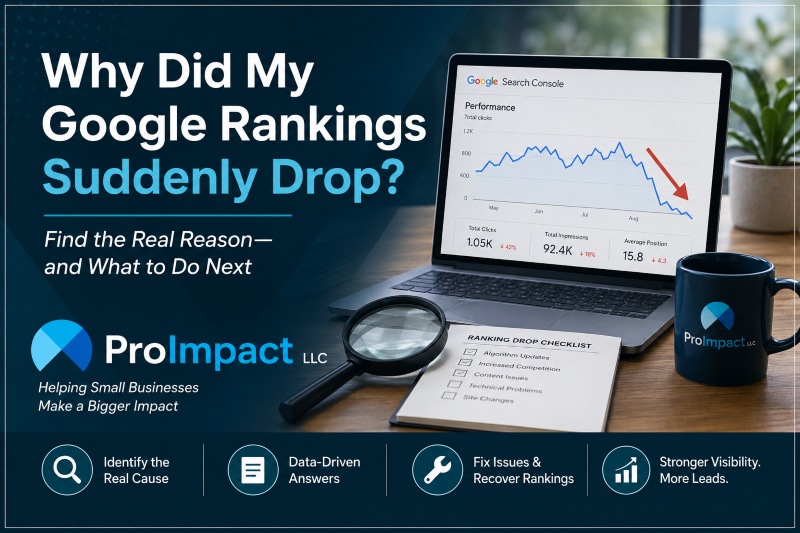
Not necessarily. Rankings naturally fluctuate because of competition, search behavior, location, algorithm changes, and many other factors. A persistent decline across several important pages or confirmed indexing problems is more useful evidence than one keyword moving a few positions.
Should I redesign my website if it is not ranking well?
Only if the condition of the website justifies it. Some sites need a redesign because the technology, structure, mobile experience, or content foundation is no longer practical to repair. Others simply need focused SEO, stronger service pages, technical cleanup, or better internal linking. Diagnosing the cause first can prevent an unnecessary rebuild.
Start With the Website Before You Assume You Need More Marketing
ProImpact can review your website's structure, content, indexing, internal links, mobile experience, performance, and technical foundation to help identify what may be helping your search visibility — and what may be working against it.