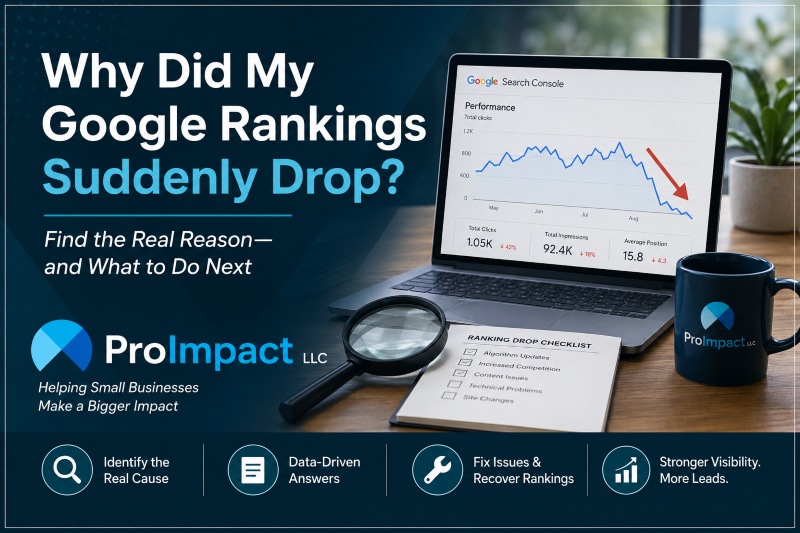

Why Your Tucson Small Business Website Isn’t Showing Up on Google
If your Tucson small business website is not showing up well in Google, the problem may not be competition or advertising budget. Weak page structure, thin service content, limited local relevance, technical issues, and unclear signals can all make it harder for Google to understand and rank the site.
Before you spend money on ads or sign up for an SEO retainer, look at what may actually be holding the site back.
Most Tucson small business owners who can’t find their website on Google assume the problem is competition. Someone bigger is outranking them. Someone is spending more on ads. The market is too crowded.
Sometimes that’s true. More often, the site itself is the problem — and it’s a problem that ads won’t fix.
Google doesn’t rank websites because they exist. It ranks websites it can understand. And a surprising number of small business websites make that harder than it needs to be.
The Homepage Is Not Enough
A lot of small business websites are built around a homepage. Maybe a services section, a contact page, an about page. That’s a start, but it’s rarely enough to compete in search.
Google needs specific pages to rank for specific searches. If you offer website design, SEO, hosting, and troubleshooting, those shouldn’t all live on one general services page. Each service needs its own page — one that explains what the service includes, who it’s for, what problems it solves, and what the visitor should do next.
A homepage can introduce the business. Individual service pages are what actually get found.
Thin Content Is a Real Problem
When I look at a small business website that isn’t ranking, weak service pages are almost always part of the picture.
A paragraph and a contact button isn’t a service page — at least not one Google will take seriously. The page has to be useful enough that a visitor who landed on it cold would actually understand the service and feel confident taking the next step.
That means clear headings, a well-written explanation of what’s included, answers to the questions customers are likely to have, and links to related pages on the site. It also means an H1 that tells Google exactly what the page is about, a meta description worth reading, and images that aren’t just decorative.
Thin content is easy to overlook because the page looks fine. It has words. It has a button. But “fine” and “competitive” are different things.
Google Needs Local Context
For a Tucson small business, local relevance matters. That doesn’t mean cramming city names into every paragraph. It means writing in a way that makes clear where you work, who you serve, and what kinds of customers you’re trying to reach.
If you serve Tucson, Oro Valley, Marana, or other nearby communities, your content should reflect that naturally — in your service pages, your blog, your metadata, and your site structure. A business that could be located anywhere will have a harder time ranking for local searches than one whose site makes its location and service area clear.
Google cannot rank what it does not clearly understand.
Technical Problems Hide in Plain Sight
Some search visibility problems have nothing to do with content.
Slow load times. Oversized images with generic filenames. Broken internal links. Redirect chains. Pages accidentally blocked from indexing. Plugins that conflict after an update. Metadata that’s missing or duplicated across pages.
None of these show up obviously when you look at the site in a browser. The page looks normal. But Google is seeing something different — a site that’s technically cluttered, slow, or harder to crawl than it should be.
Hosting matters here too. A site running on neglected shared hosting, with no one watching updates or backups, is a site that’s one bad plugin update away from a real problem.
The Answer Isn’t Always More Money
If your website isn’t showing up on Google, the instinct is often to spend — on ads, on an agency retainer, on a full redesign. Sometimes those things are the right call. But they’re the wrong starting point.
The right starting point is understanding what’s actually happening with the site.
Is the structure clear? Are the service pages useful? Is the local relevance there? Are there technical issues quietly working against you? Is the site being maintained, or just sitting there?
A practical website review can answer those questions before you commit to anything bigger. Sometimes the fix is simpler than expected. Sometimes it’s more involved. Either way, you’re better off knowing.
If your Tucson small business website isn’t performing the way you expected, start by looking honestly at what’s there. Better visibility usually starts with a better foundation — not a bigger budget.
Not Sure What’s Holding Your Site Back?
A practical website review can identify what’s helping, what’s working against you, and what should happen next — before you commit to a larger project.
Request a Website Review