
What Should a Tucson Small Business Website Include?
A small-business website does not need dozens of pages or complicated features to be effective. It does need to answer the questions a potential customer has when they arrive: Who are you? What do you do? Do you serve me? Why should I trust you? And what should I do next?
That sounds simple, but it is where many business websites fall short. A site can look attractive and still make visitors work too hard to understand what the company actually does. It can also have plenty of information but bury the phone number, contact form, service area, or next step.
When I work on website design and redesign for Tucson small businesses, I look at the website from the customer’s point of view first. Design matters, but the website also has a job to do.
Start With a Clear Explanation of What the Business Does
The homepage should not make a visitor solve a puzzle. Within a few seconds, someone should be able to understand what the business offers and whether they are in the right place.
That usually means a clear headline, a short explanation of the primary services, and an obvious path to learn more. Clever slogans can support the message, but they should not replace it. A visitor searching for a Tucson accountant, painter, counselor, storage facility, or contractor should not have to scroll halfway down the page before finding out what the company actually does.
This is especially important on mobile devices. A desktop layout may show several sections at once, while a phone shows them one at a time. The first screen has to earn the next scroll.
Give Important Services Their Own Useful Pages
A common mistake is putting every service on the homepage and assuming that is enough. The homepage should introduce the business. Important services usually deserve their own pages where the company can explain the service in enough detail to answer a customer’s questions.
Those pages also help search engines understand the website. If a company offers several different services, one general paragraph cannot explain each service as clearly as a focused page can.
That does not mean creating thin pages just to target keywords. A service page should be worth visiting. It should explain what the service includes, who it is for, what makes the company’s approach different, and what the customer should do next.
Make Tucson and the Service Area Clear
For a local business, location matters. If you serve Tucson, Oro Valley, Marana, Sahuarita, Green Valley, or other nearby communities, the website should make that clear where it is relevant.
This is not about repeating “Tucson” in every sentence. That makes a page awkward to read and does not improve the customer experience. It is about giving both customers and search engines accurate context about where the business works.
A local website should also keep basic business information consistent. The business name, phone number, service area, and contact information should not contradict what a customer sees elsewhere online.
Make the Next Step Obvious
Every important page should answer one more question: What should I do now?
For one business, that may be calling for availability. For another, it may be requesting an estimate, scheduling an appointment, completing a contact form, or starting a conversation. The action should fit the way the business actually works.
A call-to-action does not need to be aggressive. It does need to be visible. If someone has read enough to decide they want help, do not make them hunt for a phone number or figure out where the contact page is.
Build for the Phone in Your Customer’s Hand
Mobile-friendly design is no longer an extra feature. A small-business website has to work on the screen a customer is actually using.
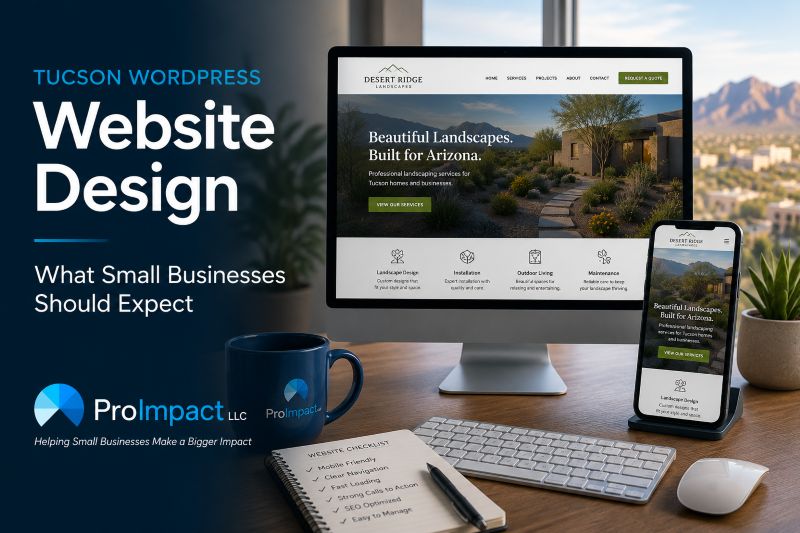
That means readable text, buttons that are easy to tap, forms that are not frustrating to complete, and pages that do not require pinching and zooming. It also means deciding what matters most on a smaller screen instead of simply shrinking the desktop version.
Mobile performance deserves attention too. Large images, unnecessary scripts, and overloaded pages can make a website feel slow even when the design looks good. A beautiful page is not very useful if a customer leaves before it finishes loading.
Give People Reasons to Trust the Business
Customers often visit a website because they are deciding whether to contact a business they do not know yet. The website should help reduce that uncertainty.
Real project examples, reviews, professional credentials, years of experience, photos of the business or team, and clear explanations of how the company works can all help. Which trust signals matter depends on the business. A contractor’s website should not look exactly like a counseling practice, and a CPA website should not be built like a storage facility.
The important point is that the website should feel like the real business behind it, not a collection of generic stock photos and marketing phrases that could belong to anyone.
Do Not Forget What Happens After the Website Is Built
A website is software. WordPress, themes, plugins, PHP, security tools, browsers, and hosting environments continue to change after the site goes live.
That is why the website also needs a plan for backups, updates, security, troubleshooting, and ongoing maintenance. I recently wrote about what website support should look like when something goes wrong, because the person running the business should not have to become the person maintaining the website.
Good design gets the website started. Ongoing management helps keep it dependable.
How Do You Know What Your Current Website Is Missing?
You do not necessarily need to rebuild it to find out. Start by looking at the website the way a first-time customer would.
Can you tell what the company does without already knowing the business? Can you find the main services? Is the service area clear? Can you contact the company easily from a phone? Do the pages answer real questions, or are they mostly general statements? Does the site still represent the business as it operates today?
If you are too close to the website to judge it objectively, a website review can help identify what is working, what is getting in the way, and whether improving the existing site makes more sense than replacing it.
Frequently Asked Questions
How many pages does a small-business website need?
There is no ideal number. Most businesses need a strong homepage, contact information, an about page, and useful pages for their most important services. The right number depends on what customers need to understand before contacting the business.
Does every small-business website need a blog?
No. A blog is useful when the business can publish helpful information that supports its services and answers questions people are searching for. A neglected blog is not automatically better than a smaller, well-maintained website.
Should I redesign my website if it is missing some of these things?
Not necessarily. Many websites can be improved without starting over. The decision should depend on the site’s structure, technology, mobile performance, content, and how difficult it is to make the changes the business now needs.
Is Your Website Doing Its Job?
If your website no longer represents your business clearly, I can help you determine whether it needs a few focused improvements or a more complete redesign. ProImpact works with small businesses that want a practical website built around what their customers actually need.