
Tucson Website Design
How Do You Choose the Right Tucson Web Design Company?
Your website does not have to be flashy. It has to help the right people understand what you do, trust your business, and take the next step. Just as important, the company that builds it should still be there after the site goes live.
When comparing Tucson web design companies, do not judge them only by how their websites look. Ask who owns the site, what happens after it launches, how it will help people find and contact your business, and whether the recommendations make sense for your budget. A good web designer should be able to explain what you need—and just as importantly, what you do not.
Choosing a web designer can be difficult because most proposals sound good on paper. You may see attractive portfolios, lists of features, promises about search visibility, hosting packages, maintenance plans, and very different prices for what appears to be the same job.
But the websites are rarely the same, and neither are the problems they are meant to solve.
A local contractor may need stronger service pages and a simple estimate request. A professional firm may need a cleaner presentation and better search structure. Another business may already have a solid WordPress site that does not need to be rebuilt at all. It may only need focused improvements to content, navigation, speed, mobile presentation, or conversion paths.
That is why I would not start by asking, “Which Tucson web design company has the best-looking websites?” I would start with a more useful question: Which company is most likely to understand what my website needs to accomplish?
Start With the Problem the Website Is Supposed to Solve
Before discussing colors, layouts, page counts, or technology, the web designer should understand why you are considering a change.
Are customers having trouble finding your services? Is the site outdated on mobile? Are you getting traffic but very few inquiries? Has the business changed while the website stayed the same? Is the current WordPress site difficult to update? Are you paying for hosting and maintenance without really knowing what is being done?
Those questions matter because a redesign is not always the answer.
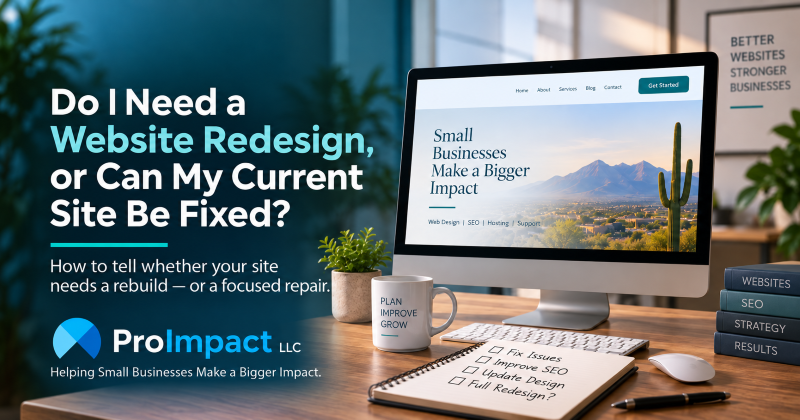
Sometimes an existing website has a sound foundation and can be improved without rebuilding everything. In other cases, years of outdated software, weak structure, poor mobile usability, thin service content, and accumulated technical problems make a redesign the more practical long-term choice.
A useful first step is a practical website review that separates what is still working from what is actually holding the site back. That makes it easier to compare recommendations instead of comparing proposals that may be solving completely different problems.
Look Beyond the Design Mockup
A website can look excellent and still create problems later if the underlying structure is weak.
For a small business, I would want to understand how the site will be built, who controls it, how easy it will be to update, what happens when WordPress or a plugin changes, and whether the company has thought about search visibility before the site goes live.
That includes practical things you should never have to become a web developer to understand: whether pages are easy to find, the site works well on phones, forms actually reach you, images load quickly, backups exist, and someone is responsible when something goes wrong. Those details may not appear in a design mockup, but they matter every day after launch.
Organic search deserves the same attention. A redesign should preserve useful URLs where appropriate, avoid creating unnecessary duplication, make important services easy for Google and visitors to understand, and support a clear organic SEO and content strategy. A new design by itself does not guarantee better rankings.
Questions About the Build
- Will I own the website, domain, content, and accounts?
- What platform and page builder will be used?
- Can another qualified WordPress professional work on the site later?
- Will the site be easy to update without rebuilding pages?
- How will mobile layouts and forms be tested?
Questions About What Happens Next
- Who handles WordPress, theme, and plugin updates?
- Are backups, security, and troubleshooting included?
- What happens when something breaks?
- Is hosting managed or simply resold?
- Who watches the site after launch?
Compare the Relationship, Not Just the Project Price
Price matters, especially for a small business. But it is easy to compare two website proposals as though they are identical when one includes very little beyond the initial build and the other includes planning, content help, search structure, hosting, maintenance, and ongoing support.
It is also worth asking what is not included. Some businesses discover after launch that routine edits are billed separately, software licenses were never theirs, hosting support is limited, backups are unclear, or nobody is responsible for keeping WordPress current.
That does not mean every business needs an expensive ongoing program. It means the arrangement should be clear.
For many small businesses, there is real value in having one person who knows the website, understands your business, and knows the history of the site. When something changes or something breaks, you are not starting over with a support ticket and explaining everything to someone new.
That is the idea behind managed WordPress hosting and maintenance: the website is treated as an ongoing business asset rather than a project that is forgotten after launch.
Ask for an Explanation You Can Understand
You should not need to become a web developer to make a good decision.
A web design company should be able to explain what it recommends in plain language: what is wrong, what can stay, what should change, what the priorities are, and what the likely tradeoffs will be. If every recommendation depends on jargon, proprietary systems, or a package that cannot be adjusted to fit the business, it becomes difficult to know what you are actually buying.
I also think it is reasonable to ask for pushback. If a business owner wants a feature that adds cost without solving a real problem, the designer should be willing to say so. If the current site can be improved instead of replaced, that should be part of the conversation. If a requested change could hurt search visibility or make the site harder to maintain, that deserves an explanation before the work begins.
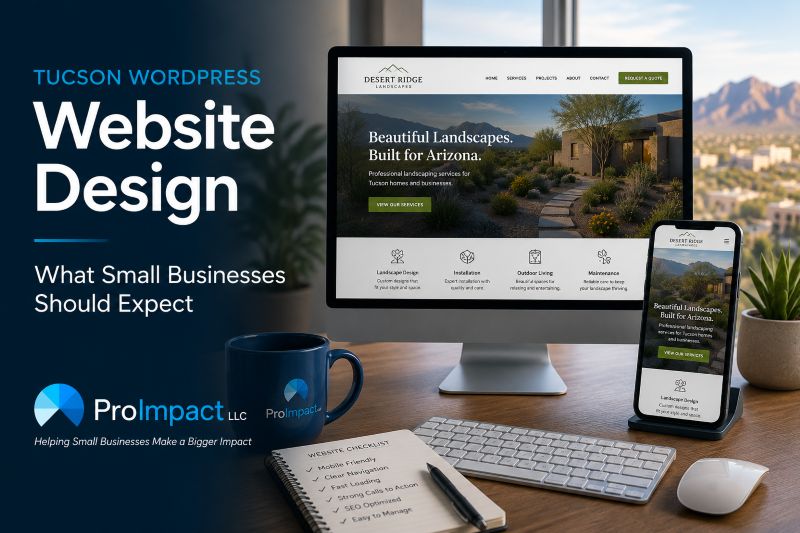
For a small business, a website should be practical. It should represent the business well, work on mobile, support organic search, make it easy for customers to take the next step, and remain manageable after the initial project is finished.
What Happens After the Website Goes Live?
Launching the website is not the finish line. WordPress changes, browsers change, phones change, Google changes, and your business changes. Forms need testing, software needs attention, content gets outdated, and sometimes something simply stops working.
This is where small-business owners can end up frustrated. The person who built the site is gone, the hosting company only handles the server, and nobody is actually responsible for the website as a whole.
That is why I believe support after launch should be part of the decision from the beginning. You should know who to call, what they are responsible for, and whether they know your site well enough to solve a problem without starting from scratch.
Questions Small Business Owners Often Ask
Should I choose a Tucson web designer based on price?
Price should be part of the decision, but compare the scope as well. A lower quote may exclude content work, SEO setup, hosting, maintenance, security, backups, or post-launch support. Make sure you understand what each proposal actually includes.
Do I need a local web design company?
Not necessarily. Good web work can be done remotely. A local Tucson provider can be useful when local market knowledge, face-to-face communication, or long-term local support matters to you, but the quality of the work and the clarity of the relationship are more important than proximity alone.
Should SEO be included in a website redesign?
At minimum, the redesign should account for SEO fundamentals such as page structure, titles, headings, internal links, mobile usability, indexing, redirects when needed, and preserving valuable existing URLs. Ongoing organic SEO and content work may be a separate service.
You May Not Need a New Website
If you are comparing Tucson web design companies, start by finding out what your current website actually needs. Sometimes the right answer is a redesign. Sometimes it is a focused repair, better content, better hosting, or a few changes that help the site do its job. I would rather tell you that than sell you a website you may not need.