Your Website Isn’t Broken Because It’s Old. It’s Broken Because Nobody Has Been Managing It.
A small business website can still look fine on the surface while quietly losing speed, rankings, leads, and trust. The problem is often not simply age — it is that no one has been consistently reviewing, maintaining, and improving the site as the business, technology, and search environment change.
A small business website can still look fine on the surface while quietly losing speed, rankings, leads, and trust.
A small business website rarely breaks all at once. More often, it slowly stops doing its job while still looking familiar enough that no one feels an immediate need to question it.
The home page still loads. The logo is still there. The phone number may be correct. The site may even look acceptable on a desktop computer. But behind the scenes, the conditions around that website have changed. WordPress has changed. Plugins have changed. Google has changed. Hosting environments have changed. Competitors have improved their service pages, added better content, and made their websites easier to understand.
That is why a website can become less effective long before it looks completely outdated. It may still be online, but it may not be doing the work the business needs it to do. It may be slower than it should be, weaker in search than it once was, harder to update, or quietly losing leads because no one is testing the forms, reviewing the content, or watching how the site performs.
The problem is not always that the website is too old. Sometimes the real problem is that nobody has been managing it.
A Website Can Look Fine and Still Be Failing
One of the most common mistakes small business owners make is assuming that if a website still appears online, it is still working. That is understandable. Most business owners are busy running the business, not inspecting their website every week.
But a website can look fine and still have problems that affect leads, search visibility, trust, and usability. A page can load but still be too slow. A contact form can appear normal but fail to deliver messages. A service page can describe the business but not answer what customers are actually searching for. A site can look attractive but still have weak structure, outdated content, poor internal linking, or technical issues that are easy to miss.
This is why a practical website review matters. A website is not a printed brochure that gets finished and left alone. It lives in a changing environment. The longer it sits without review, the more likely it is that parts of it will fall behind.
Websites Drift When Nobody Owns Them
Many small business websites suffer from what I think of as website drift. No one intentionally lets the site decline. It just happens over time.
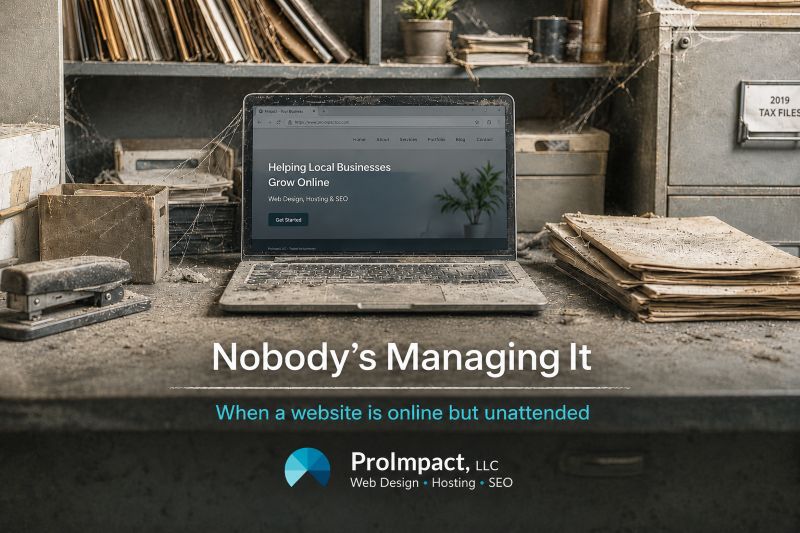
The site gets built, launched, and loaded onto a large hosting platform like GoDaddy or another mass-market provider. After that, it can become something like an item placed on a dusty shelf; forgotten and unattended, but still technically there. The monthly or annual charge may keep renewing. The website may still be accessible. But no one is really looking at it, checking on it, improving it, or asking whether it is still doing what the business needs it to do.
A page gets added without thinking about how it fits into the rest of the site. A plugin gets installed and never reviewed again. A service changes, but the website does not. A former designer, employee, or agency had access, but now no one knows exactly what was done. Hosting renews automatically. Domain records are forgotten. Analytics are installed but never checked. The site keeps existing, but no one is really responsible for whether it is still helping the business.
At first, the issues may seem small. A layout looks a little off on mobile. A page has outdated wording. A form notification goes to an old email address. A blog category becomes cluttered. A service page lacks enough local detail. None of those things may feel like an emergency by themselves.
But together, they create a website that is harder for visitors to trust and harder for Google to understand.
Old Content Creates Old Impressions
A website does not have to look outdated to feel outdated. Sometimes the bigger issue is the content.
If your website still describes your business the way it operated several years ago, visitors may notice the disconnect. If your service pages are too general, they may not answer the specific questions people have today. If your blog has not been updated in years, it can make the business feel inactive even when the business itself is doing just fine.
Old content can also affect search performance. Google is not simply looking for pages that exist. It is trying to understand which pages are helpful, relevant, and useful for the person searching. A service page that was adequate five years ago may not be strong enough today if competitors have added clearer structure, better local detail, stronger service explanations, and more helpful answers.
This does not always mean the whole website needs to be rebuilt. Sometimes the better first step is to review the content, identify what is weak, and improve the pages that matter most through a focused organic SEO and content strategy.
SEO Does Not Maintain Itself
Search engine optimization is not something you finish once and forget. A page may rank well for a while and then begin to slip. That does not always mean something is broken. It may mean competitors improved their pages. It may mean Google is rewarding more useful content. It may mean the page is too narrow, too thin, poorly structured, or missing the questions people now expect answered.
For many small businesses, SEO depends on a few practical things working together: clear service pages, strong local relevance, useful headings, natural internal links, updated content, fast pages, and a site structure that helps both visitors and search engines understand what the business does.
If no one reviews those pieces over time, the website can slowly lose ground. That is why a website should not only be judged by how it looks. It should also be judged by whether it is still helping people find, understand, and contact the business.
WordPress Needs Oversight, Not Just Updates
Many small business websites are built with WordPress, and WordPress is a good platform when it is managed properly. But “managed properly” does not only mean clicking update buttons.
Plugins need to be reviewed. Themes need to remain compatible. Security tools need to be checked. Backups need to exist before something goes wrong. Forms need to be tested. Speed tools need to be configured carefully. PHP versions change. Hosting environments change. A plugin that worked well last year may create problems after another update.
The point is not to scare business owners. The point is that WordPress needs oversight. A neglected WordPress site may still run for years, but that does not mean it is healthy. Like any business tool, it needs someone paying attention before small issues become larger problems. That is where WordPress hosting and maintenance becomes part of keeping the site useful, secure, and easier to manage.
Hosting, Email, Forms, and Security Are Part of the Website Too
Many website problems are not only design problems. A business owner may say, “My website has a problem,” but the real issue might involve hosting, DNS, email delivery, contact forms, spam filtering, SSL certificates, backups, security settings, or plugin conflicts.
To the customer, none of those details matter. They simply know the form did not work, the page loaded slowly, the site looked suspicious, or the email never arrived. From their point of view, the business had a website problem.
That is why website management needs to look at the whole picture. A website is not just the pages people see. It is the system behind those pages. If that system is not being watched, the business can lose leads without realizing it. When those hidden issues start showing up, website troubleshooting and support can help identify what is really going wrong.
Sometimes You Need a Redesign. Sometimes You Need Better Management.
A redesign can absolutely be the right answer. Some websites really are too outdated. Some are difficult to edit. Some have poor mobile layouts, weak navigation, old branding, or structural problems that are easier to fix by rebuilding the site properly.
But not every website problem requires starting over. Sometimes the smarter move is to improve what is already there. Strengthen the service pages. Clean up the navigation. Fix technical problems. Update content. Improve internal links. Review SEO titles and descriptions. Test forms. Check speed. Make sure the site is secure, backed up, and easier to manage going forward.
A good website review should not begin with the assumption that everything needs to be replaced. It should begin with a practical question: what is keeping this website from doing a better job for the business? If the answer is structural, then a thoughtful website design or redesign may be the right move. If the foundation is still solid, better management may be the smarter first step.
What ProImpact Looks For When Reviewing a Website
At ProImpact, we look at small business websites from a practical standpoint. The goal is not to chase trends or add features just because they are new. The goal is to understand whether the website is still supporting the business.
That means looking at the site from several angles. Is the content clear? Are the important services easy to find? Does the site reflect what the business actually does today? Are the pages strong enough for local search? Are forms working? Is the site mobile-friendly? Is it being maintained, updated, backed up, and monitored? Are there hidden issues that could affect leads, trust, or performance?
For some businesses, the answer may be a redesign. For others, it may be better maintenance, stronger content, improved SEO structure, or ongoing website support. The important thing is that someone needs to own the website after it goes live.
Your Website Should Not Be Left on Its Own
A small business website is not a one-time project. It is part of the business. It needs care, review, updates, and direction.
When no one is managing it, the site may continue to exist, but it may slowly stop helping the business the way it should. The decline is not always obvious at first. It may show up as fewer leads, weaker search visibility, slower pages, outdated content, broken forms, or the growing feeling that the website no longer represents the business very well.
So if your website feels old, slow, confusing, neglected, or less effective than it used to be, the answer may not be to panic. The better first step is to look closely.
Your website may not be broken because it is old. It may be broken because nobody has been managing it.
Is Your Website Still Doing Its Job?
If your website feels outdated, neglected, slow, confusing, or less effective than it used to be, ProImpact can take a practical look at what is working, what is not, and what should happen next.
You may need a redesign. You may need better maintenance. You may need stronger content or help solving hidden technical issues. The first step is understanding the difference.
Request a Website Review