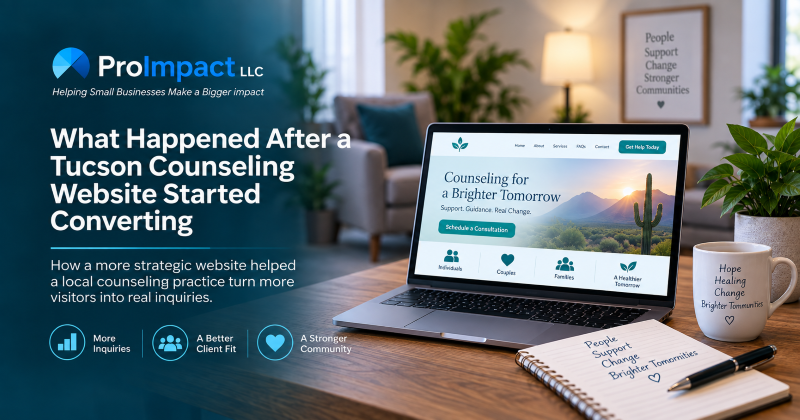
What Happened After a Tucson Counseling Website Started Converting
Getting a website to appear in search is important. But for a small business or organization, visibility only becomes valuable when the right people visit the site, understand what is being offered, and take the next step.
Last week, I wrote about a question I hear often from small-business owners: why does my website show up in Google but not generate leads? That article focused on the difference between search visibility and conversion. This week, I want to show what that difference can look like in the real world.
The example is a Tucson counseling organization I have worked with over an extended period of time. I am intentionally leaving the organization unnamed because the point is not to promote the client. The point is to look at what changed when the website became more useful to the people who were actually searching for counseling services.
The site did not suddenly become successful because of one keyword, one design change, or one search ranking. The improvement came from a series of practical changes that made the website easier to find, easier to understand, and easier to act on.
Search visibility created the opportunity. Clear service pages, stronger local relevance, better paths to contact, and ongoing website management helped turn that opportunity into actual inquiries.
The Website Was Getting Found — But That Was Only the Beginning
Counseling is a good example of why website traffic alone does not tell the whole story. Someone searching for a counselor is rarely browsing casually. They may be looking for help with anxiety, marriage problems, grief, depression, family conflict, trauma, or another very specific concern.
That means the website has to do more than rank for a broad phrase such as “counseling Tucson.” It needs to help a visitor quickly determine whether the organization works with the problem they are facing, whether services are available in a convenient location, whether the approach feels appropriate, and what they should do next.
Over time, we expanded and improved individual service pages, strengthened local relevance, clarified calls to action, improved page structure, and paid closer attention to the questions prospective clients were actually asking.
Those changes supported organic search, but they also improved something that is just as important: what happened after a visitor arrived.
of tracked leads came from the website
Over the broader tracking period, website-generated inquiries became one of the organization’s largest lead sources.
in some months
In stronger months, the website approached half of the organization’s reported incoming opportunities.
web inquiries in five recent months
From April through August, the website generated 133 recorded inquiries across the organization.
I would not use the number 133 by itself as the headline for this story. Without context, a raw inquiry count does not tell us very much. What matters is that the website developed into a consistent source of new opportunities rather than simply being an online brochure.
What Changed Was the Path From Search to Contact
One of the biggest lessons from this project is that conversion improvement does not necessarily require flashy design or aggressive sales language. For a counseling website, that would probably work against the organization.
Instead, the site needed to reduce uncertainty. A prospective client should not have to search through a general services page and wonder whether a counselor works with teenagers, couples, grief, anxiety, trauma, or another specific issue. Relevant service pages gave search engines more context, but they also gave visitors clearer answers.
More specific service content
Individual counseling topics were developed into stronger pages instead of expecting one general counseling page to answer every visitor’s question.
Better local relevance
The website made it easier for people searching in different parts of the Tucson area to understand where services were available and whether a location made sense for them.
Clearer next steps
Contact opportunities were made more obvious so that a visitor who was ready to ask about counseling did not have to figure out where to go next.
Ongoing refinement instead of a one-time launch
Search behavior, page performance, inquiries, and client feedback continued to influence what we improved next. The website was managed as an active business asset rather than a project that was finished the day it launched.
The Lead Data Told Us Something Search Rankings Could Not
SEO reports are useful. I watch rankings, impressions, clicks, search queries, indexing, and other visibility signals. But none of those numbers tells me whether someone actually contacted the organization.
That is why lead-source information became especially valuable in this project. The organization was tracking where inquiries came from, including referrals, doctors’ offices, online search, returning clients, employee assistance programs, churches, directories, and other sources.
Seeing the website consistently account for a substantial portion of those opportunities gave us a much better measure of success than simply saying a keyword moved from position 12 to position 5.
Rankings still matter because they help create visibility. But the business value comes from the combination of being found for the right searches and having a website that gives the visitor a reason to continue.
A website does not need every visitor to become a lead. It needs to help the right visitor understand, trust, and act. That is a very different goal from simply trying to increase traffic.
More Traffic Would Not Have Fixed the Original Problem by Itself
It is tempting to look at a website that is not generating enough inquiries and conclude that it needs more visitors. Sometimes that is true. But driving additional traffic to a website that does not communicate clearly can simply produce more people who leave.
A better first question is whether the site is doing its job with the traffic it already has. Does the page answer the reason someone searched? Does it demonstrate that the organization understands the visitor’s need? Is the service available where the visitor lives? Is the next step obvious? Does the website feel current, credible, and trustworthy on a phone?
Those are conversion questions, but they also overlap with good organic SEO. Useful service content, logical page structure, local relevance, internal linking, clear headings, and a website that works properly all help people and search engines understand the business more clearly.
That is why I generally do not separate website design, organic SEO, and conversion into three unrelated projects. They affect one another.
ProImpact’s Organic SEO & Content Strategy work focuses on that broader picture rather than chasing rankings in isolation.
What Should a Small Business Take From This Case Study?
A counseling organization is different from a painter, accountant, attorney, home-service company, or retailer. But the underlying website problem is often the same.
People search because they need something. Your website has to connect that search to a clear answer and then make the next step comfortable and obvious.
You can see examples of the kinds of websites we build and support on View Our Work.
Is Your Website Getting Found but Still Not Producing Enough Inquiries?
More traffic may not be the first thing you need. A practical website review can help identify where visitors are losing confidence, missing important information, or abandoning the path to contact.