Why Does My Website Show Up in Google but Not Generate Leads?
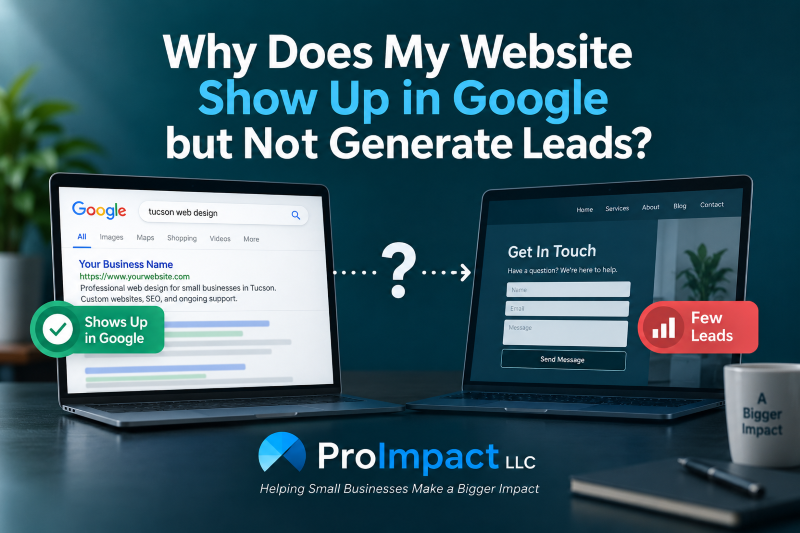
Showing up in Google is only one part of the job. A website can rank for useful searches and still fail to generate inquiries if visitors do not immediately understand what the business offers, why they should trust it, whether it serves their area, or what they should do next.
If your website shows up in Google but does not generate leads, the problem is often not visibility — it is conversion. Common causes include weak or unclear messaging, poor search intent alignment, generic service pages, weak calls to action, missing trust signals, slow or awkward mobile pages, and contact forms that create too much friction. The right fix starts by finding where visitors are losing confidence or direction after they arrive.
Small-business owners are often told that better rankings will solve their website problems. Rankings matter, and stronger organic visibility can absolutely create more opportunities. But a page-one position is not the same thing as a lead.
A visitor can find your website, click through, look around for twenty seconds, and leave without contacting you. If that happens often enough, the website may be doing one part of its job well while failing at the next part.
This is why traffic and rankings should never be reviewed in isolation. The better question is whether the website is attracting the right people and making it easy for those visitors to understand the business, trust what they see, and take the next step.
Ranking in Google and Generating Leads Are Different Jobs
Organic SEO helps a website become visible for relevant searches. Conversion happens after the click.
Search visibility depends on whether Google can understand the page, whether it is relevant to the query, whether the website has enough useful content and context, and whether it can compete with other available results. Once someone reaches the site, a different set of questions takes over.
Does this business offer what I need? Is it local? Does the website look credible? Can I quickly understand the service? Is there proof that the company knows what it is doing? Can I easily contact someone?
Search visibility gets someone to the door. The website still has to give that person a reason to walk through it.
That distinction is important because it changes where you look for the problem. If rankings and impressions are strong but inquiries are weak, rewriting title tags may not be the highest priority. The problem may be the page experience after the click.
Why Website Traffic Does Not Always Turn Into Leads
When a website is visible but not generating enough inquiries, the problem usually falls into a handful of practical categories. More than one may be happening at the same time.
The Searcher Is Not Really Looking for What You Sell
A page can rank for a phrase that appears relevant but attracts the wrong intent. Someone searching for “website design ideas” may be looking for inspiration rather than a local designer. A person searching “how to fix WordPress” may want a do-it-yourself answer rather than professional support.
Good organic SEO should not focus only on getting more traffic. It should help the right pages appear for searches that have a reasonable connection to the services the business actually wants to sell.
The Page Does Not Make the Offer Clear Enough
Visitors should not need to study the website to understand what the business does. A vague headline, generic introduction, or page filled with broad marketing language can leave a potential customer unsure whether the company actually provides the service they searched for.
Strong service pages clearly explain the service, who it is for, the problems it solves, where it is available, and what the visitor should do next.
The Website Does Not Build Enough Trust
Searchers are often comparing several businesses at once. If one website clearly shows experience, real projects, useful explanations, local information, testimonials, credentials, and a professional presentation while another feels thin or anonymous, the stronger site usually has the advantage.
This is one reason ProImpact treats website design as more than appearance. The site has to support credibility, search visibility, and real inquiries together. That same principle is reflected in ProImpact's small-business website work.
The Call to Action Is Too Weak or Too Hard to Find
“Learn More” is not always enough. A visitor who is ready to talk should be able to see the next step without searching through the navigation or scrolling to the footer.
The best call to action depends on the business. It may be a consultation, estimate request, appointment, phone call, showing inquiry, service request, or simple conversation. What matters is that it is obvious and appropriate for the visitor's stage in the decision.
The Contact Process Creates Friction
Long forms, confusing required fields, broken forms, poor mobile layouts, unclear submission buttons, or no confirmation after sending can quietly reduce inquiries.
A form does not need to be extremely short if the business genuinely needs the information. But every field should earn its place. Someone who has already decided to contact you should not be given a reason to abandon the process.
The Page Experience Is Poor on Mobile
A desktop website can look fine while the mobile version feels cramped, slow, difficult to scan, or awkward to navigate. That is especially damaging for local service businesses because many searchers are using a phone when they are ready to call, request service, or compare nearby providers.
How to Tell Whether You Have a Traffic Problem or a Conversion Problem
The distinction becomes clearer when you compare search visibility with what visitors do after they arrive.
Not Enough Qualified People Are Reaching the Site
Important service pages receive few impressions, rankings remain weak, or the website appears mostly for searches that do not match the business.
This points more strongly toward organic SEO, service-page structure, content depth, local relevance, indexing, or competition.
People Reach the Site but Rarely Take the Next Step
Relevant pages receive impressions and clicks, but the business sees few calls, forms, appointments, estimates, or other meaningful inquiries.
This points more strongly toward messaging, trust, user experience, calls to action, forms, page design, or a mismatch between the search and the offer.
In many cases, the website has some of both. A service page may rank reasonably well but still attract the wrong mix of searches. Another page may bring qualified visitors but fail to explain the service well enough to convert them.
That is why ProImpact's organic SEO and content strategy focuses on the website itself — service pages, useful content, internal linking, metadata, structure, and clear paths toward the services that matter.
What a Lead-Generating Service Page Should Make Clear
A visitor should be able to answer several basic questions without working very hard. If those answers are missing, buried, or vague, ranking alone may not be enough to produce an inquiry.
What Exactly Do You Offer?
Use direct language. If you provide website redesign, counseling, painting, accounting, HVAC repair, or another specific service, make that clear early rather than hiding it inside general brand language.
Who Is the Service For?
A visitor wants to know whether the company works with businesses like theirs, homeowners like them, or customers with the specific problem they are trying to solve.
Why Should Someone Trust You?
Real experience, useful explanations, examples of work, testimonials, professional credentials, service history, and accurate local information can all reduce uncertainty.
Where Do You Work?
Local service businesses should make their location and service area clear. A searcher should not need to dig through a contact page to determine whether the company serves Tucson, Oro Valley, Marana, or another community.
What Should the Visitor Do Next?
The page should make the next step obvious. A clear request for a website review, estimate, appointment, consultation, or conversation is usually stronger than expecting visitors to figure it out themselves.
More Traffic Is Not Always the Best First Fix
When leads are weak, it is tempting to assume the answer is simply more traffic. Sometimes it is. But increasing traffic to a page that already confuses visitors can just increase the number of people who leave.
Before spending money or time trying to double website traffic, make sure the existing traffic has a reasonable chance of converting. Review the pages people actually enter from search. Look at the message they see first. Test the contact forms. Review the mobile experience. Confirm that the calls to action are visible and that the page delivers what the search result appeared to promise.
In some cases, relatively small improvements can make a meaningful difference: a clearer opening statement, stronger service detail, better proof, a visible phone number, a simpler form, a stronger CTA, or a more direct explanation of where the company works.
In other cases, the problem is broader. The site may have thin content, outdated design, weak navigation, poor performance, or several disconnected issues working against each other. A practical website review can help separate what actually needs attention from what is already working.
Questions About Website Traffic and Leads
Can a website rank well and still have a poor conversion rate?
Yes. Rankings and conversions measure different parts of the customer journey. A page can be visible for relevant searches but still lose potential customers because of weak messaging, poor trust signals, confusing navigation, difficult forms, or an unclear next step.
Does low lead volume always mean the website is the problem?
No. Lead volume can also be affected by seasonality, competition, pricing, demand, reputation, market conditions, or the types of searches generating the traffic. The website should be evaluated as part of the larger picture rather than assumed to be the only cause.
Should I redesign my website if traffic is not converting?
Not automatically. Sometimes a focused improvement to messaging, service content, calls to action, forms, or mobile usability is enough. A redesign makes more sense when several structural, technical, content, and usability problems are working together.
What should I check first if Google traffic is not producing inquiries?
Start with the landing pages receiving organic traffic. Confirm that the search intent matches the service, the page clearly explains the offer, the business looks credible, the CTA is easy to find, and the contact process works properly on both desktop and mobile.
Find Out What Is Keeping Visitors From Becoming Leads
ProImpact can review your search visibility, important landing pages, messaging, calls to action, internal links, forms, mobile experience, and overall website structure to help identify where potential customers may be getting lost.